Last Updated: June 2026
Reviewed By: UploadArticle Editorial Team
What Is UploadArticle SEO?
UploadArticle SEO is the practice of publishing optimized articles on an article submission platform to earn backlinks, gain keyword visibility, and build trust signals that support your site’s rankings. It sits between content creation and off-page SEO every article you upload either becomes a genuine ranking asset or, if rushed and unoptimized, adds nothing at all.
The appeal is straightforward. A well-placed submission offers three real outcomes: a contextual backlink to your site, a secondary page that can rank on its own for long-tail keywords, and referral traffic from readers already browsing the platform. None of these are guaranteed they depend entirely on the quality of what you publish and how it’s optimized before submission.
How UploadArticle SEO Works
1. You publish on an established platform. A platform Google already crawls frequently and trusts gives your content a stronger starting point than publishing on a brand-new, unindexed site.
2. The article includes a contextual backlink. Placed naturally within the body, not stuffed into the author bio, the link points to a relevant page on your site.
3. Crawl efficiency speeds up discovery. Established platforms get crawled more frequently than smaller or newer sites, so new articles and the links inside them tend to get found and indexed faster.
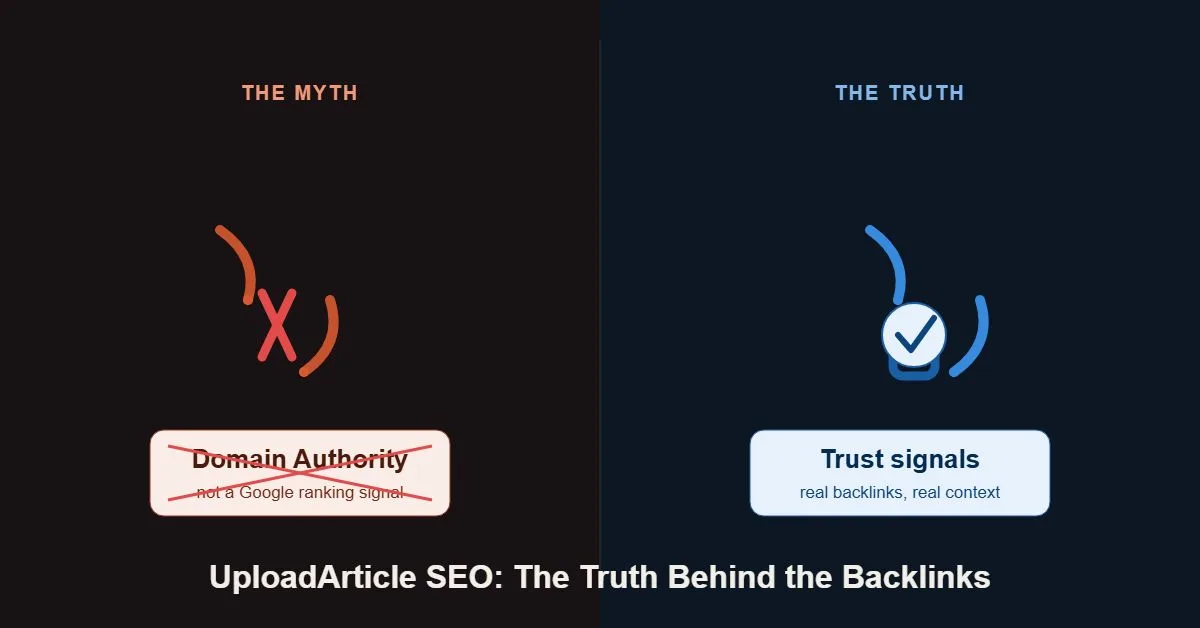
4. The backlink contributes to your site’s trust signals. Google does not use Domain Authority (DA) that’s a third-party metric created by Moz, not something Google’s algorithm reads directly. What Google does evaluate is backlink quality, relevance, and context. A natural link from an established, topically relevant platform feeds into that evaluation over time.
5. The article can build topical authority on its own. When you publish multiple articles around a consistent subject and interlink them, search engines start to see a coherent topic cluster rather than scattered, disconnected pages strengthening relevance for the whole group, not just one URL.
Key Benefits
Contextual Backlinks
A relevant, naturally placed link from a trusted platform carries more weight than a generic directory link or a forced anchor text. It reads as an editorial reference, which is exactly how search engines evaluate it.
Faster Indexing Through Crawl Efficiency
High-authority platforms get crawled frequently, sometimes daily. Submitting your article’s URL through Google Search Console after publishing can accelerate this further, especially for newer websites with limited crawl history of their own.
Keyword Visibility on a Second Page
A properly optimized article can rank independently for its own target keyword, giving you an additional entry point into search results beyond your main site.
Topical Authority Through Interlinking
Publishing several articles around one core subject and linking them together signals topic depth. Search engines reward content and contributor profiles that demonstrate consistent expertise in a subject rather than scattered, unrelated content.
Backlink Diversity
A natural backlink profile includes links from multiple sources. Distributing content across reputable platforms, rather than relying on one domain, looks organic and reduces risk.
Compounding, Long-Term Value
Unlike paid placements that stop the moment a budget runs out, a published article keeps generating backlink value and referral traffic indefinitely as long as the platform and the content remain live.

Step-by-Step Optimization Checklist
Before writing
- Pick one primary keyword and 3–5 semantic variations to weave in naturally
- Check what’s already ranking for that keyword and note what it’s missing
- Match length to intent informational topics generally need real depth, not padding, to be comprehensive
While writing
- Use the primary keyword once in the title, once in the opening paragraph, and naturally across a few subheadings
- Break content with headings every 200–300 words and use lists where they genuinely help
- Place 1–2 contextual backlinks inside the body where they add value to the point being made not in the conclusion or bio alone
- Use branded or descriptive anchor text rather than exact-match keyword anchors
- Write for the reader first; a search engine reads the same content second
Before submitting
- Confirm the article fits the platform’s category guidelines
- Check every outbound link resolves correctly (a broken or redirecting link is a common rejection reason)
- Use a real author identity name, short bio, and a link to a professional profile. Content tied to a verifiable author carries more trust than something published under a generic username
- Proofread for originality; duplicate or recycled content is the most common reason for rejection
After publishing
- Submit the URL through Google Search Console to support faster indexing
- Track referral traffic with UTM parameters
- Note which platforms and topics perform best, and repeat what works
Common Mistakes That Waste the Opportunity
| Mistake | Why It Hurts | The Fix |
| Mass submission of the same article | Spun or duplicate content across many sites risks being treated as a link scheme | Publish fewer, genuinely original pieces |
| Keyword stuffing | Disrupts readability and can trigger spam filters | Use the keyword naturally, not on repeat |
| Exact-match anchor text everywhere | Looks manipulative to search engines | Vary anchors branded, descriptive, natural phrasing |
| No real author identity | Content with no traceable author carries less trust | Use a real name, bio, and profile link |
| Links only in the author bio | Misses the chance for a contextual, value-adding link | Place 1–2 links inside the relevant part of the article |
| Inconsistent publishing | Sends unreliable signals and kills topical momentum | Publish on a steady, realistic schedule |
| Wrong category placement | Reduces visibility to the audience that would actually read it | Match the article to its most relevant niche |
UploadArticle SEO vs. Traditional On-Page SEO
| Factor | Traditional SEO | UploadArticle SEO |
| Where the work happens | On your own website | On an external publishing platform |
| Primary focus | Site structure, technical SEO, page-level metadata | Content distribution and backlink building |
| Trust building | Built gradually through owned content and links earned over time | Some trust signal transfer from a relevant, established platform dependent on link quality and context, not automatic |
| Time to indexing | Depends on your own site’s crawl frequency and history | Often faster on platforms with high crawl frequency |
| Best used for | Long-term site foundation | Supplementary off-page authority and link diversity |
These aren’t competing strategies. Article submission sits in the supplementary layer of an SEO plan useful for extending reach and diversifying links, but not a substitute for a solid on-site foundation.
Where It Fits in a Broader SEO Strategy
A sensible order of priorities looks like this: build a strong foundation of first quality content on your own site plus genuine technical and on-page optimization. Then focus on core off-page work earning links through original content and outreach to relevant publications. Article submission platforms belong in the supplementary layer after that, extending reach rather than replacing the groundwork.
Treated in that order, it’s a useful, modest channel. Treated as a shortcut to skip the foundational work, it adds very little.
How Long Does It Take to See Results?
Indexing of a new article and the backlink inside it can happen within days on a frequently crawled platform, though it varies. Measurable movement in rankings from accumulated backlink value typically takes longer, often building over weeks to months of consistent, quality publishing rather than from a single submission.
Frequently Asked Questions
Does publishing on UploadArticle guarantee higher rankings?
No. It can contribute to rankings through a contextual backlink and a secondary indexable page, but the outcome depends on content quality, your site’s existing authority, and competition for the keyword. No single platform guarantees a ranking improvement.
Does UploadArticle SEO improve my Domain Authority score?
Domain Authority is a third-party metric created by Moz Google does not use it as a ranking factor. Tools like Moz, Ahrefs, or Semrush may show DA or DR changes after you earn backlinks, but those scores are external estimates of ranking potential, not something Google itself measures. What actually matters to Google is backlink quality, relevance, and your site’s overall trust signals; DA is simply one way SEOs approximate that from the outside.
How many backlinks should one article include?
One or two, placed naturally within the body where they genuinely add value. More than that tends to look promotional and can hurt both reader trust and approval chances.
Is keyword density something to track?
Not as a strict percentage. Natural usage appearing because the topic requires it, not to hit a number matters far more than density math.
Can article submission alone replace a full SEO strategy?
No. It strengthens off-page trust signals and backlink diversity but works best as one part of a broader strategy that includes on-site optimization and consistent original content.
Can this approach hurt my site if done badly?
Yes. Submitting duplicate or thin content across many low-quality platforms can be treated as a link scheme and risk a penalty. Done thoughtfully original content, natural links, a real author it doesn’t carry that risk.
The Bottom Line
UploadArticle SEO is a modest, legitimate distribution channel, not a shortcut. It rewards the same things Google rewards everywhere: original content, natural linking, a real identifiable author, and genuine usefulness to the reader. Approached that way, it earns a place in a broader SEO strategy. Approached as a quick backlink trick, it delivers about as much as shortcuts usually do.